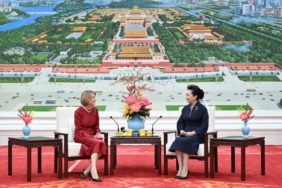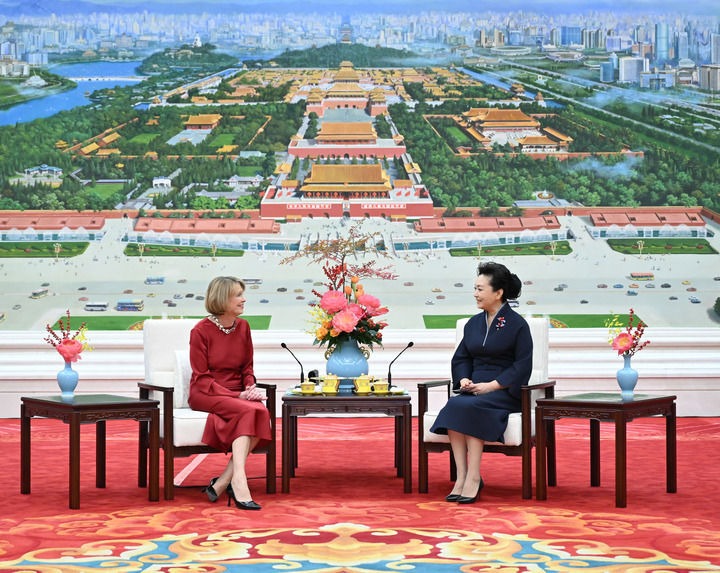
Peng Liyuan and Elke Buedenbender met at a Beijing tea reception on Friday, reviewing expanding cultural partnerships between China and Germany across educational networks and digital media exchanges following German President Frank-Walter Steinmeier’s official visit from October 27 to October 31.
During the gathering, Peng recalled her 2017 visit to Germany with President Xi Jinping and commended Buedenbender’s ongoing initiatives advocating for the rights and interests of women and children. The two attendees viewed a short film dedicated to bilateral people-to-people initiatives and cross-cultural programs.
Peng stated that the two nations have engaged in and benefited from rich and diverse collaborations in sectors such as education and culture, expressing her hope that the Chinese and German people would maintain continuous cultural exchanges, enhance mutual understanding, and build stronger friendship bonds.
Buedenbender thanked Peng for the warm hospitality, praised her contributions to cultural exchange and people-to-people interactions between the two countries, and stated that she is ready to contribute to stronger cooperation in relevant fields and to a deeper friendship between the two peoples.
Collaborative Programs and Cultural Initiatives
The bilateral interaction spans an interconnected framework encompassing language training, academic initiatives, arts, and tourism. In Hanover, the Leibniz Confucius Institute manages summer camps, remote language partner systems, and speech contests. Concurrently, the Bonn-based Burg Chinese Choir escorted 80 students and teachers to Yunnan province, where participants learned over 60 Chinese songs and attended the Yi Torch Festival.
Public events continue to utilize music, art, and modern multimedia to facilitate educational outreach. Berlin’s Rotes Rathaus marked its 12th consecutive Chinese New Year gala for 300 guests, while Frankfurt featured street performances by the Chaoshan Yingge dance troupe alongside Ansai waist drummers. In Duisburg, festival programming combined tai chi, electronic pop music, and film screenings, while an exhibition in Chengdu convened German and Chinese artists exploring the intersection of technology and perception.
Travel and institutional connections have expanded alongside cultural programming. A Gansu cultural tourism event in Berlin drew over 40 German travel sector delegates, and an agency organized a 38-caravan tour stretching from Turkey to China. Throughout 2026, China’s visa-free entry policy for German citizens remained operational, supporting bilateral transit and cross-border connectivity.